Welcome to the Land of the Broad-winged Hawk
Posted on in In the Field by Lucie Donadille, Autumn 2026 Conservation Science Trainee
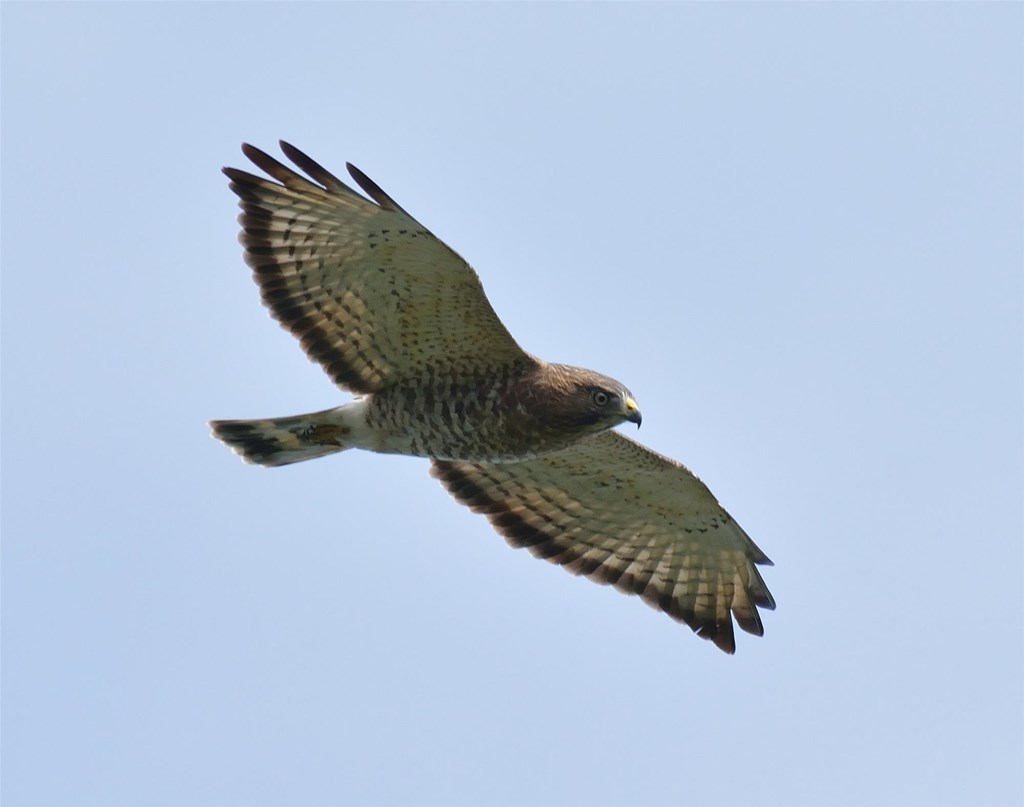
The Conservation Science staff, including the five Conservation Science trainees, are busy with the migration count that runs from mid-August to mid-December. The most abundant species recorded during fall migration is the broad-winged hawk. Hawk Mountain counts around 8,000 on average, but this season we’ve surpassed the average counting 11, 696 thus far, with a peak one-day count of 2,909 streaming past the lookout.
Beyond its apparent abundance, the various migration counts through North America have showed a decrease in eastern populations. In addition, its breeding distribution has declined by 16% in Pennsylvania since the 1980s. To understand the origin of this decline, Hawk Mountain Sanctuary launched the Broad-winged Hawk project in 2014, aiming to better understand their ecology and threats throughout their full annual cycle.
At the start of breeding season in the spring, Conservation Science trainees, under the guidance of Dr. Laurie Goodrich and Dr. Rebecca McCabe, participated in nest searching and monitoring. Finding the nests can be quite challenging, as the broad-winged hawk can be elusive; nesting high in the treetops and quietly hunting under the forest canopy. However, our motivated research team managed to find several nests, with the help of committed volunteers and landowners. Once nests are confirmed active, the project will monitor the nests throughout the breeding season to confirm success or failure and number of young fledged. In addition, some individuals were trapped and tagged with GPS-GSM transmitters to obtain valuable information on their movements.
Now that the broad-winged hawk breeding season is over, it’s time for habitat sampling!
On the last day of August, we took advantage of the beautiful weather to go back to the nesting sites to collect data on the habitat. Fall Conservation Science trainees had the opportunity to assist Dr. Laurie Goodrich and Dr. Rebecca McCabe in collecting that data in the field, hoping to have the chance to see an adult or a juvenile gearing up for autumn migration.
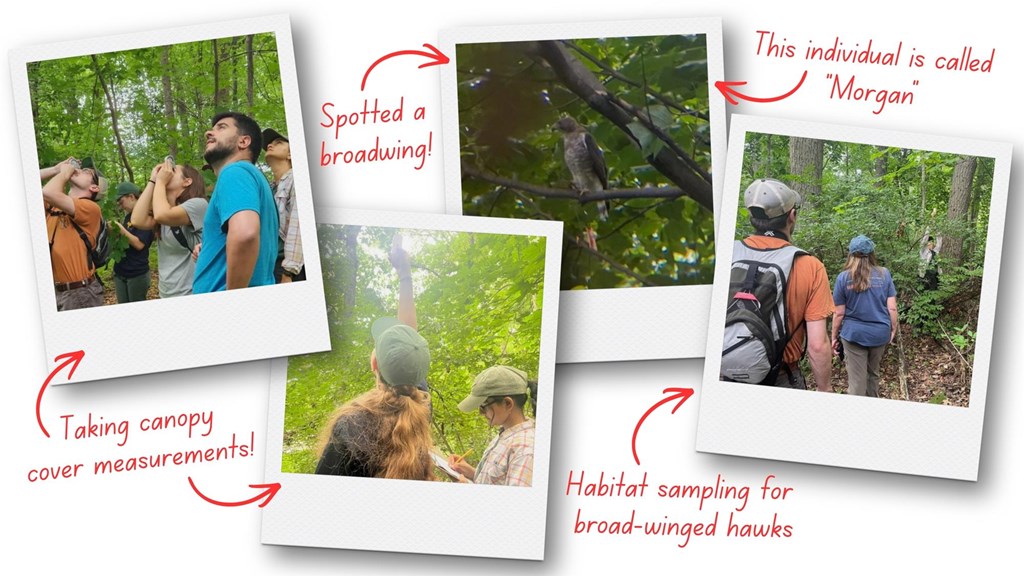
The first nesting site gave us the chance to practice identifying tree species and learn how to take vegetation measurements—canopy cover, diameter and height of the nesting tree, height of the nest—using homemade or more sophisticated tools like a clinometer. The nest was located on private property in Narvon, Pennsylvania, and fortunately our team was not only granted access to monitor the nest and collect vegetation data, but the family developed a keen interest in following the close observation of tagged adult, its mate, and young.
As we arrived at the second nest, also on private land and monitored by long-time volunteers Holly and Steve Hartshorne, we caught glimpse of a silhouette perched in the tree. It took flight stealthily through the forest: “a broad-winged hawk!” After waiting a few minutes, the bird came back and perched on a branch, just below the forest canopy. We had the chance to observe it for a few minutes before it returned to the forest. Just long enough for us to identify him: it’s Morgan (short for Morgantown), the male who was trapped and tagged earlier this summer! This day in the field enabled us to describe Morgan's breeding habitat to better preserve it.
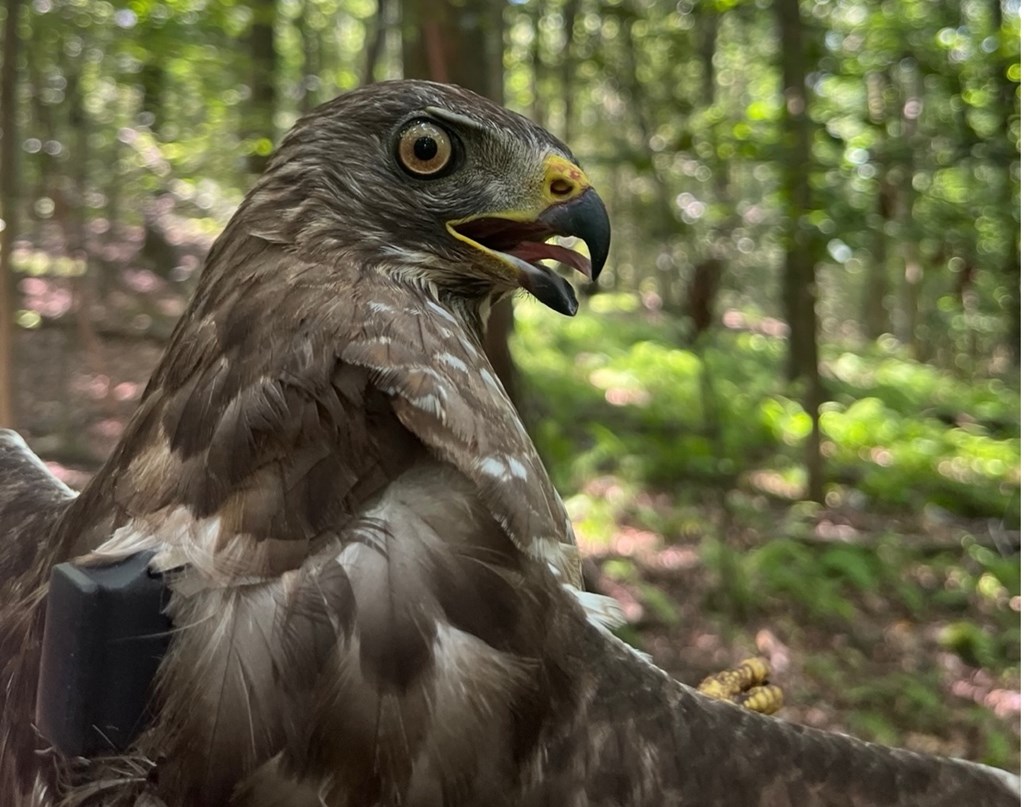
Morgan just moments before being released. Birds were handled for the purpose of scientific research under a federally authorized Bird Banding Permit issued by the U.S. Geological Survey and in accordance with all state permitting requirements.
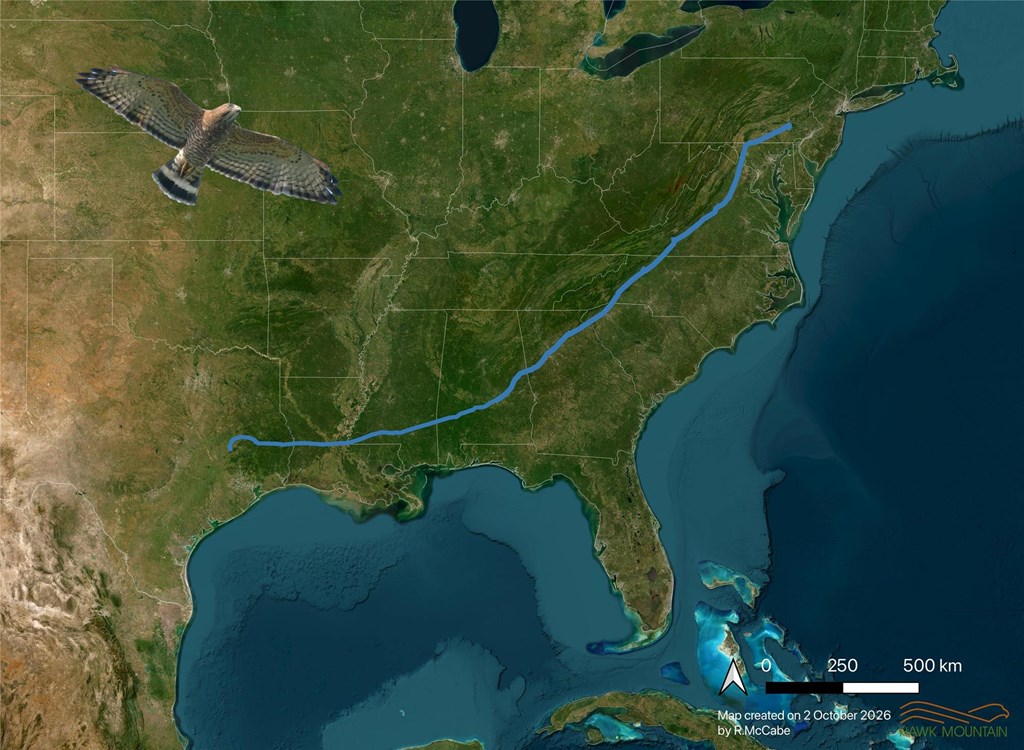
Morgan's movements from 19 August to 2 October 2026
Last update: Shortly after our visit, Morgan began his migratory journey in mid-September and has travelled over 2,000 km (1,243 mi) to Texas. Thanks to his GPS tag, we will be able to track him throughout his migration, providing us with valuable information to understand the ecology and target conservation actions for the species across its range.