Life in the Fast Lane: Banding the World’s Smallest Birds
Posted on in In the Field by Emily Jones, Spring 2025 Conservation Science Trainee
Many hawkwatchers and bird lovers travel to Hawk Mountain Sanctuary to witness the incredible phenomenon that is raptor migration. The number of raptors counted at the North and South Lookouts averages 972 individuals in the spring and 17,827 in the fall, (Hawk Mountain Sanctuary, 2026). While most people expect Hawk Mountain to only study raptors, as it is the oldest bird of prey sanctuary in North America, there are other non-raptor studies that the sanctuary staff and volunteers participate in when they have time.
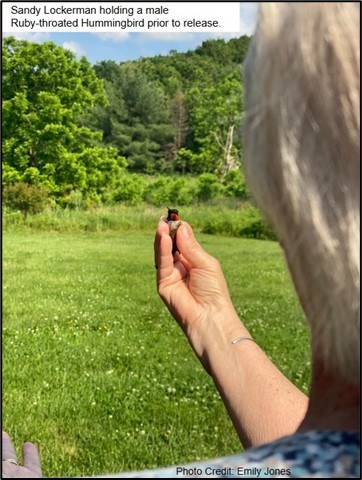
One of Hawk Mountain's volunteers, Sandy Lockerman, of Harrisburg, spends a majority of her summer months working with hummingbirds across Pennsylvania.
I first met Sandy Lockerman in the Spring of 2025. Sandy arrived at Hawk Mountain Sanctuary on 10 June 2025, to conduct a ruby-throated hummingbird (Archilochus colubris) banding demonstration for the Spring 2025 class of Conservation Science Trainees. As she started to unpack her things, her husband Gary, was busy setting up his handmade hummingbird trap at the feeder, and us trainees watched in wonder at the tools she used to band the smallest birds in the world. Sandy Lockerman talked us through everything we needed to know about her banding process while we waited patiently for a hummingbird to decide to drink from the feeder. We waited for a little over an hour for a hummingbird to arrive, but it didn’t feel that long with all of the knowledge we were absorbing from Sandy. She told us amazing stories of rare bird captures, working with other banders across the U.S., and some of her most memorable banding experiences. After talking with Sandy, I was surprised to hear that she was one of the few hummingbird banders in the state of Pennsylvania!
Bird banding is an important scientific practice conducted only by trained professionals. You must be trained by other banders and demonstrate banding experience to obtain a federally-authorized bird banding permit. For example, Sandy trained with ornithologist and author, Scott Weidensaul, for fifteen years as a subpermittee under Scott’s master banding permit before she received her own master banding permit. Sandy and Scott travelled to banding stations across the southern United States to learn from other master banders, including Gulf Shores and Birmingham, Alabama, as well as southwest Texas (Lockerman, S., pers. comm., July 19, 2025). In Pennsylvania, all banders are required to have both state and federal bird banding permits, and must report their data to both agencies at the end of their banding season. Hummingbird banders are a small subset of banders and they need additional training to demonstrate their ability to handle this small, fragile bird.
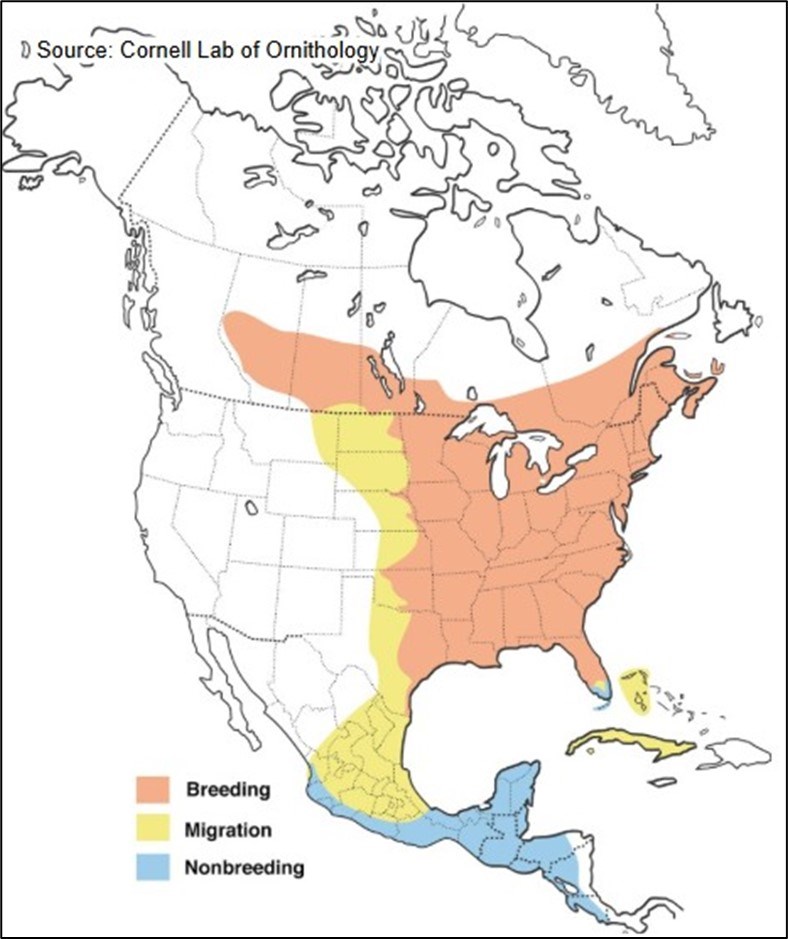
Hummingbirds are some of the smallest birds in the world, with females averaging 3.5 grams and males averaging 3 grams. You would think that such tiny birds could not handle a strenuous migration, but that is not the case. Like other migratory species, ruby-throated hummingbirds migrate because their breeding grounds in southern Canada and central and eastern United States become too cold in the winter and essential food supplies, flower nectar and insects disappear. So they must migrate south to southern Florida, Mexico and Central America (Cornell Lab of Ornithology, 2026). According to the Cornell Lab of Ornithology’s Birds of the World website (2020), many ruby-throated hummingbirds will fly nonstop across the Gulf of Mexico during migration, a round-trip that is more than 1,600 kilometers. The life of a ruby-throated hummingbird takes place in the fast lane, with pairs only staying together long enough for courtship and mating. Adult males will begin their fall migration before the females, leaving the females to care for the young on their own (Weidensaul et al., 2020). It is truly fascinating the lengthy distance that hummingbirds will migrate and their capability to store enough fat to survive the challenging journey. So how do they do it?
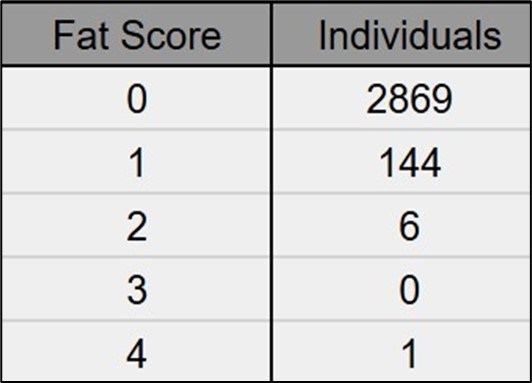
While we were sitting around the picnic table waiting for the trap to trigger, I asked Sandy if the hummingbirds they trap have a lot of fat stored in preparation for migration. She explained that when she catches them in July and August in central Pennsylvania, they do not have much fat on them. In the southern United States, ruby-throated hummingbirds can double their weight before crossing the Gulf of Mexico, which is when they would have high concentrations of fat stored (Lockerman, S., pers. comm., July 19, 2025). The table to the left shows fat scores of 3,020 ruby-throated hummingbirds captured from 2007 to 2023 in Coburn, Pennsylvania. “Fat score” is a measurement that bird banders use to describe how much fat a bird has stored in their body. Fat deposits are yellow, which stand out from the nearby pink skin, and is visible by gently blowing the hummingbird’s feathers out of the way. For Sandy’s data set, the fat score ranges from 0-4. You can see from the table that most of the ruby-throated hummingbirds in Sandy’s study area have little fat when she bands them.
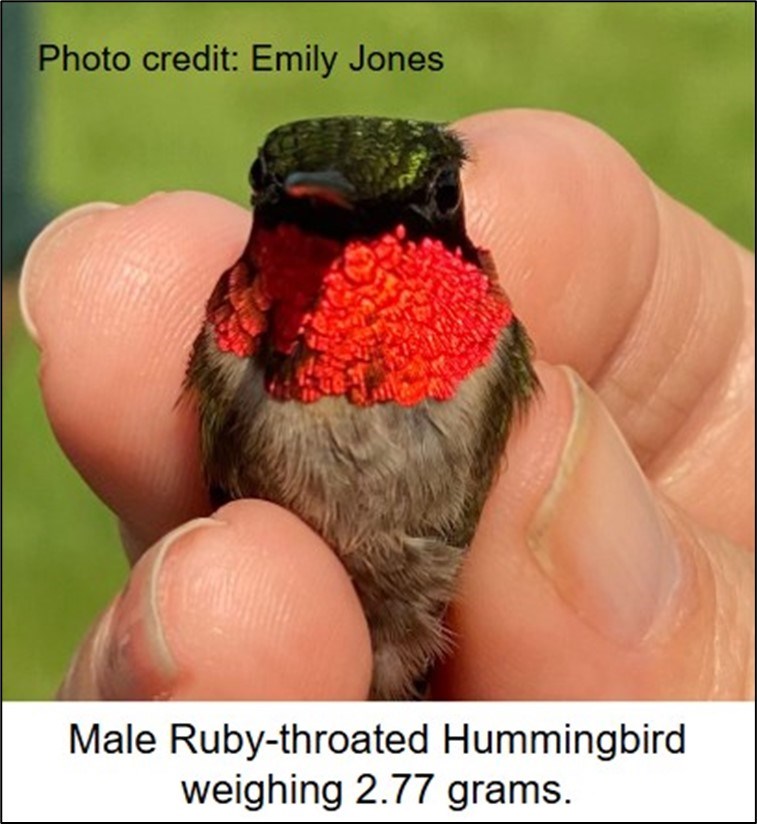
Finally, a male hummingbird was caught in the trap and we gathered around Sandy to watch the demonstration. Weighing only 2.77 grams (a little more than the weight of a penny) this male ruby-throated hummingbird was the highlight of my day. I had never seen a hummingbird up-close before, and I remember holding my breath in anticipation as Sandy gingerly began the banding process. While she banded and took measurements, one of the trainees copied the information to her banding sheet, and the rest of us watched quietly in wonder. Since it was a male that was caught, Sandy showed us the iridescent red throat patch, called a “gorget,” as it shimmered in the sunlight.
Just like Hawk Mountain, Sandy understands the importance of collecting long-term data. She has been banding ruby-throated hummingbirds in central Pennsylvania since 2007, making her data set quite valuable when looking at trends.
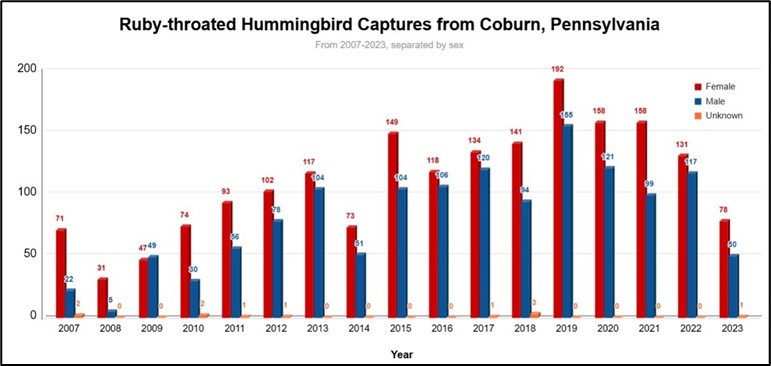
From Sandy’s 17 year dataset, we can see that more females are captured annually with 2009 being the exception. Whether this is due to males leaving shortly after mating or another reason that is unknown, it is a dominant trend. For this dataset, the adults are classified as AHY (after hatching year) and the juveniles are classified as HY (hatch year). For both males and females, more adults were caught than juveniles. This may be due to the time of year that Sandy focuses on trapping. Most of her trapping efforts have taken place in July and August. Adult males typically migrate first, followed by the adult females and juveniles, so it makes sense she would catch more adults than hatch years.
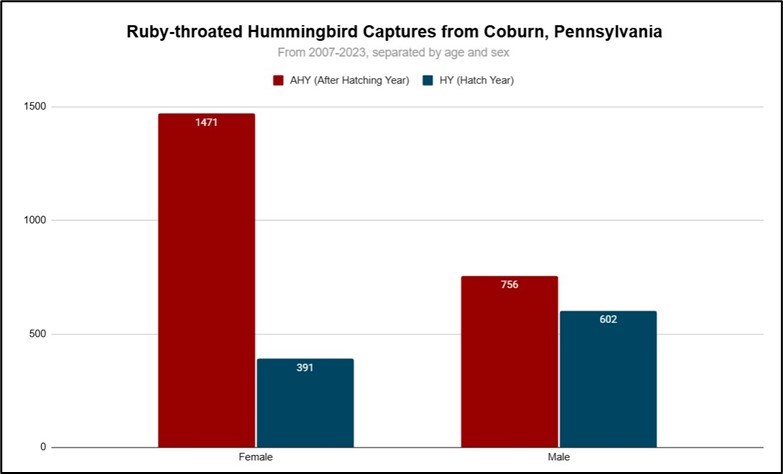
On average, Sandy traps and bands close to 200 ruby-throated hummingbirds at this location each year, with a total of 3,239 individuals (1867 females and 1361 males) banded since she started this study.
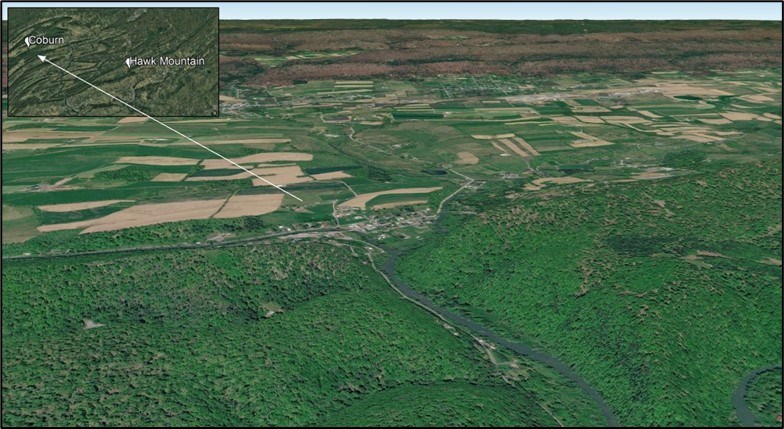
Although Sandy performed the banding demonstration at Hawk Mountain, all 3,239 ruby-throated hummingbirds from this data set were captured, banded, and released at a different location: a home near Coburn, Pennsylvania. To the south of Coburn, Pennsylvania, there is a creek that runs through a ridgeline which you can see from the terrain map below. The homeowners had been feeding hummingbirds for over 25 years, going through 250 pounds of sugar every summer (Lockerman, S., pers. comm., July 19, 2025). Sandy told me that she chose this site for her study area as she is looking at the use of ridges in central Pennsylvania as migration routes. She stated that there were many hummingbirds at her study area in May and June, but were local birds in their breeding range, so they were not the birds she was targeting for her migration study. Sandy is aiming to capture the ruby-throated hummingbirds that are migrating south from the northern states and utilize the ridges of central Pennsylvania to migrate the long distance.
Since Maurice Broun began counting raptors in 1934, hummingbirds have been counted daily at Hawk Mountain and today many other watch sites record daily numbers in the northeastern United States. Average counts of hummingbirds at Hawk Mountain are 336 hummingbirds per fall season with a one-day peak count of 20 to 30 birds each year. A special study of hummingbird migration was conducted in 1985 using data from seven hawkwatch sites in the northeast United States, to supplement observations from Hawk Mountain. Wind velocity and direction were found to be a strong influence on sightings at Hawk Mountain, with the highest counts of migrating hummingbirds being on days with strong northwest winds (Willimont et al., 1988).
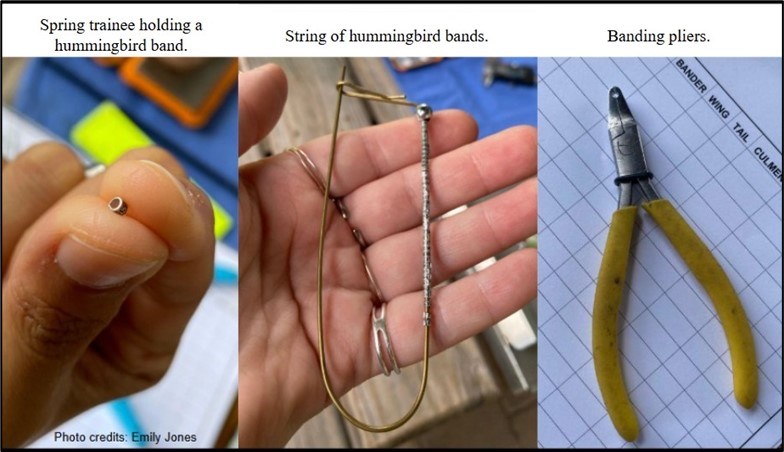
In the United States, bird banders receive their federal aluminum bands from the United States Geological Survey’s Bird Banding Laboratory. Usually, these bands come on a string or wire and are separated into individual bands already. Hummingbird bands are the exception. With tarsi (legs) so small, hummingbird bands come as a sheet and must be cut and formed into a band by the permitted bander. With an internal diameter of 1.27-1.52 mm and a height of 1.6 mm, it is the smallest band a permitted bander can receive (United States Geological Survey, 2026). Once cut and formed, it is applied to one of the legs, or tarsi, using banding pliers that ensure it fits properly. Next, measurements are taken, such as: wing length, tail, and culmen length; mass, fat score; and age/sex if possible to determine. This information is important to collect so researchers can learn as much as possible about the species. The entire process takes less than five minutes, and does not harm the bird. When all the banding and measurements are done, the hummingbird is released by placing it in the palm of a hand and waiting until it is ready to fly away.
Recovery of a bird band provides useful knowledge about that individual bird and their species as a whole, which can be used for research and conservation studies. It can reveal information about migration and dispersal, behavior and social structure, life span, population studies, estimation of survival and productivity, and aid in toxicology and disease research (United States Geological Survey, 2020). More information can be found here from the United States Geological Survey’s website.
So what can you do to help these incredible birds? Feed them, of course! Providing nectar-filled hummingbird feeders during the migration period and summer months can help these little birds fuel the long and strenuous journey south - just be sure to clean feeders regularly to avoid mold buildup which can harm the hummingbirds. If possible, planting native flowering plants is another way to provide natural food for hummingbirds.
The Department of Conservation and Natural Resources has a butterfly/hummingbird native plant garden template that you can find here. An article from Bright Lane Gardens also provides a list of native hummingbird plants for Pennsylvania here.
All banding reported here was conducted under a federal Bird Banding Permit and Pennsylvania state Bird Banding Permit issued by the U.S. Geological Survey's Bird Banding Lab.
References
Cornell Lab of Ornithology. (2020, March 4). Ruby-throated Hummingbird - Archilochus colubris. Birds of the World. Retrieved from https://birdsoftheworld.org/bow/species/rthhum/1.0/introduction.
Cornell Lab of Ornithology. (2026). Ruby-throated Hummingbird Overview. All About Birds. Retrieved from https://www.allaboutbirds.org/guide/Ruby-throated_Hummingbird/overview.
Hawk Mountain Sanctuary. (2026). Science - Migration Count. Migration Data. Retrieved from /conservation-science/resources/migration-data.
Ohler, A. (2025, October 27). Top Native Hummingbird Plants for Pennsylvania Gardens. Bright Lane Gardens. Pennsylvania Native Plants. https://brightlanegardens.com/native-plants/midwest-native-plants/pennsylvania-native-plants/pennsylvania-native-hummingbird-plants/.
United States Geological Survey. (2020, January 2). Why Do We Band Birds? U.S. Geological Survey. Retrieved from https://www.usgs.gov/labs/bird-banding-laboratory/science/why-do-we-band-birds.
United States Geological Survey. (2026). Bird Banding Laboratory Banding Portal. U.S. Geological Survey. Retrieved from https://www.pwrc.usgs.gov/BBL/Bander_Portal/login/sizes.php.
Weidensaul, S., T. R. Robinson, R. R. Sargent, M. B. Sargent, and T. J. Zenzal Jr. (2020). Ruby-throated Hummingbird (Archilochus colubris), version 1.0. In Birds of the World (P. G. Rodewald, Editor). Cornell Lab of Ornithology, Ithaca, NY, USA. https://doi.org/10.2173/bow.rthhum.01
Willimont, L. A., S. E. Senner, and L. J. Goodrich. (1988). Fall migration of Ruby-throated Hummingbirds in the northeastern United States. Wilson Bulletin 100:482–488.